

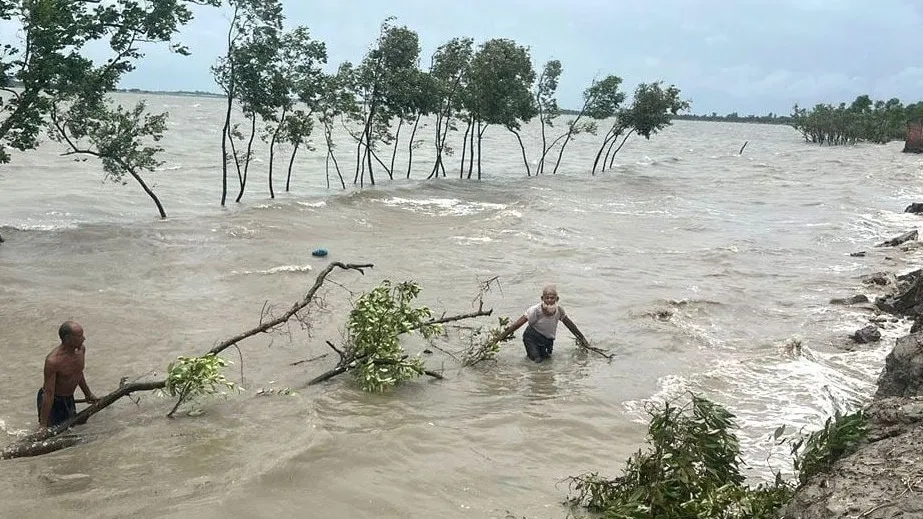
In the southwestern coastal district of Satkhira, climate change is no longer a distant warning. It is a daily struggle for survival, as rising salinity, cyclones, tidal surges, river erosion and rising sea levels threaten agriculture, fisheries, livestock and access to safe drinking water.
Across the district's seven upazilas, increasing soil salinity is damaging vast areas of cultivable land, reducing food production, raising farming costs and putting the livelihoods of millions of people at risk. Experts estimate that around 1.8 to 2 million people in Satkhira are directly or indirectly affected by climate change, with farming families, fishers, day labourers and women agricultural workers among the most vulnerable.
Rokeya Begum, a resident of Nildumur villager at Shyamnagar upaziala, said salinity destroyed almost all freshwater sources in her locality. "There is a plenty of water around us but no water to drink. We have to walk around three kilometres every day to fetch drinking water," she said.
The situation is particularly severe in Shyamnagar, Ashashuni, Kaliganj and Debhata, where salinity continues to rise, undermining the production of rice, wheat, pulses, vegetables and fruits.
Once known for fields capable of producing two or three crops a year, many parts of Satkhira now struggle to sustain conventional agriculture. Farmers are increasingly turning to salt-tolerant rice varieties, while some have converted cropland into shrimp enclosures and crab farms to maintain their incomes. Although these alternatives offer economic opportunities, the expansion of aquaculture can also reduce land available for food crops and contribute to long-term soil degradation.
The crisis extends beyond agriculture. Salinity has made water from many ponds, canals and shallow tubewells unsuitable for drinking and household use. Some families must pay for safe drinking water every day, placing an additional financial burden on households already struggling with declining incomes.
Public health experts warn that the lack of safe water increases the risk of diarrhoeal diseases, high blood pressure, kidney problems and skin conditions. Women in highly saline coastal communities also report serious reproductive health problems, although the extent to which salinity contributes to specific gynaecological conditions requires further medical investigation.
Women bear a disproportionate burden
In Gabura, an island union under Shyamnagar Upazila bordering the Sundarbans, 32-year-old Asma Begum of Sora village's Ward No. 9 underwent surgery to have her uterus removed eight years ago, when she was just 23.
"I began experiencing burning sensations and pain in my uterus after the birth of my first child," she said. "After having three children, I learned that I had developed sores in my uterus. My condition became very serious. I was admitted to a hospital in Khulna, where doctors removed my uterus through surgery."
Asma, whose parental and marital homes are both in Gabura, said she had lived with saline water since birth. But she believes the problem has worsened over the years.
"During the summer, the water becomes so salty that I cannot even put pond water in my mouth. Yet we have to use that same water for bathing and other household activities," she said.
Her neighbour, Rowshan Ara Parvin, now 28, underwent a similar operation at a younger age. She said doctors removed her entire uterus after a tumour was detected about four years ago.
Both women say their husbands subsequently left them and married elsewhere.
Their experiences reflect the overlapping health, social and economic vulnerabilities faced by women in coastal communities. Locals say women in villages heavily affected by salinity suffer from various reproductive health conditions, while limited access to healthcare and safe water adds to their hardship.
However, establishing a direct medical link between saline water and specific uterine diseases requires further clinical research.