

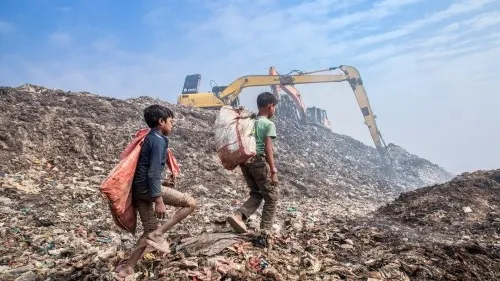
Children carrying sacks across towering piles of garbage at the Anandabazar waste dump in Halishahar, Chattogram, are raising concerns over child labour, workplace safety and the right to education.
Surrounded by plastic, decomposing waste and discarded materials, the children work near heavy machinery at the dump, where informal waste pickers collect recyclable items to earn a living. The scene highlights the risks children may face when poverty and limited livelihood opportunities push them into hazardous working environments.
Informal waste pickers at the site collect plastic, metal and other reusable materials from discarded waste. Children are also involved in this work, although the circumstances of each child's involvement require individual assessment.
A study on waste pickers at Anandabazar, published in the Asian Journal of Applied Sciences in 2023, found that 13 per cent of the surveyed waste pickers were aged 15 or below. The research also highlighted long working hours, inadequate living conditions and various health risks among the participants.
The researchers emphasised the need to protect children involved in informal waste recycling and help them access education and appropriate social protection.
Working at a waste dump can expose children to sharp glass, metal fragments, needles, contaminated materials and moving heavy vehicles. Smoke and heat from fires at waste sites may pose additional dangers. A lack of protective equipment and access to healthcare can further increase these risks.
The potential consequences extend beyond physical injuries. Long hours of work may interfere with children's schooling, rest, recreation and overall development. When children miss educational opportunities to help support their families, their prospects for better employment and a more secure future may also be undermined.
Bangladesh's labour laws prohibit the employment of children in certain occupations and establishments and impose restrictions on the employment of adolescents in hazardous work. International Labour Organization standards also call for protection against work that may harm the health, safety or morals of people under 18.
Addressing child labour at waste disposal sites such as Anandabazar requires coordinated measures, including identifying children engaged in hazardous work, helping them leave dangerous jobs, facilitating their return to school and providing social assistance to vulnerable families.
Improving access to alternative livelihoods, healthcare and safer waste-management systems is also essential to reducing families' dependence on children's earnings.
The sight of children carrying sacks across piles of rubbish is more than an image of difficult working conditions. It highlights a broader concern: children may be sacrificing their safety, education and childhood to meet immediate economic needs.
Every child has the right to grow up in a safe environment, receive an education and remain protected from exploitation and hazardous labour.