

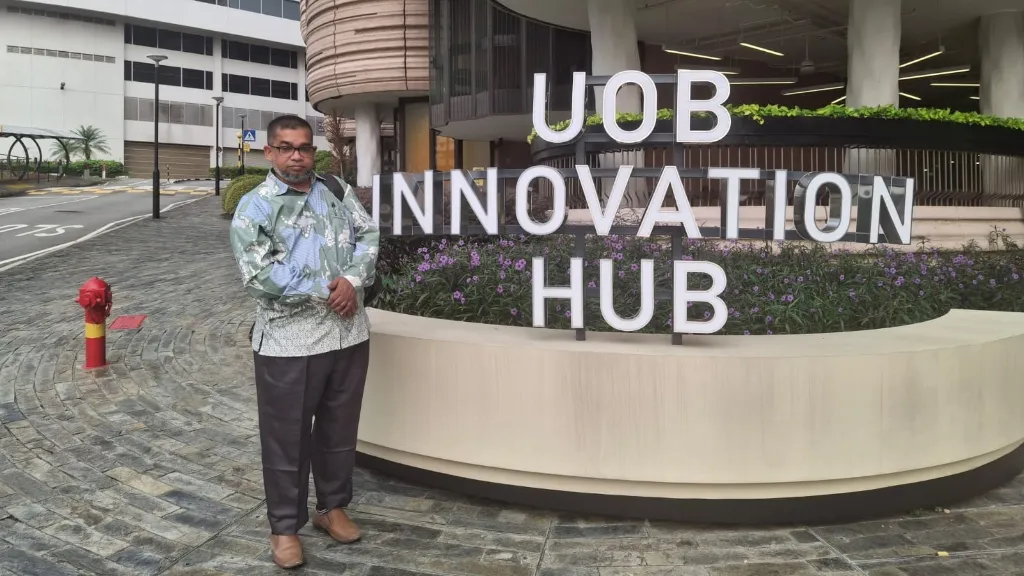
Visiting a world-class university is always a memorable experience, but visiting Nanyang Technological University (NTU) Singapore was something more than an ordinary academic tour. It was an inspiring journey into a world where academic excellence, cutting-edge research, technological innovation, sustainability and institutional heritage come together.
During my recent visit to NTU Singapore, I was deeply impressed by its remarkable campus, vibrant academic environment and strong research culture. From its modern architecture and beautifully landscaped surroundings to its laboratories, research facilities and international academic community, almost every aspect of the university reflects a clear commitment to excellence and innovation.
A Legacy of Educational Excellence
NTU's story is closely connected with the history of Singapore's higher education. Its roots can be traced back to Nanyang University, established in 1955. Over the decades, the institution evolved in response to Singapore's changing educational and economic needs and ultimately became Nanyang Technological University in 1991.
From those beginnings, NTU has transformed itself into one of Asia's and the world's most respected research-intensive universities.
What makes its development particularly impressive is the way the university has combined its historical identity with a forward-looking vision. Its heritage has not become a limitation; rather, it has provided a foundation upon which a modern, globally connected research university has been built.
One of the World's Top Universities
Today, NTU is recognised as one of the world's leading universities. Its strong performance in international rankings reflects its academic reputation, research achievements, international outlook and contribution to innovation.
The university is particularly renowned for engineering, technology, computer science, artificial intelligence, materials science, business and the sciences. Its global standing in engineering and technology is especially noteworthy.
For academics and researchers, this reputation is significant because it demonstrates how sustained investment in research, innovation, talent development and international collaboration can transform a university into a global centre of knowledge.
Standing on the NTU campus, I could appreciate that the university's reputation is not simply a matter of ranking. Its global identity is visible in the academic atmosphere, research orientation and international character of the institution.
A Research-Driven University
The most striking impression I took from NTU was its strong identity as a research university.
In the modern world, universities are no longer expected merely to transmit existing knowledge. They are increasingly required to create new knowledge and develop solutions to complex global problems.
NTU is strongly engaged in research areas such as artificial intelligence, advanced materials, environmental sustainability, energy, water, biomedical sciences, digital technologies, climate-related challenges and smart urban development.
Such research has significance far beyond the university campus. Many of these areas are directly connected with the challenges facing countries across Asia and the wider world.
The university's interdisciplinary approach is particularly important. Modern challenges cannot always be solved by one discipline alone. Engineering, science, medicine, technology, economics and social sciences increasingly need to work together.
NTU provides an impressive example of how a research university can create an environment that encourages such collaboration.
Engineering and Technology at the Forefront
NTU's international reputation in engineering and technology was another aspect that particularly caught my attention.
The university has established itself as a global centre for engineering research, with considerable strength in fields including civil and structural engineering, electrical and electronic engineering, mechanical engineering, materials science and computer science.
For professionals and researchers interested in infrastructure, construction, smart cities and sustainable development, NTU offers an especially valuable academic environment.
The rapid development of cities across Asia has created enormous challenges involving transportation, housing, infrastructure, climate resilience, energy efficiency and environmental protection.
Research universities such as NTU can play a crucial role in addressing these challenges by connecting advanced scientific knowledge with practical applications.
The Campus: A World of Its Own
Perhaps the most unforgettable part of my visit was the NTU campus itself.
The campus is spacious, green and architecturally distinctive. Modern academic buildings stand alongside extensive greenery, creating an environment that is both technologically advanced and remarkably natural.
One of the most recognisable landmarks is The Hive, whose distinctive honeycomb-inspired design has become an architectural symbol of NTU.
As I walked through the campus, I was fascinated by the way architecture, technology and nature had been integrated into the university environment.
The campus seemed to communicate an important idea: a university should be more than a collection of classrooms and offices—it should be an environment that stimulates curiosity, creativity and intellectual engagement.
Sustainability in Practice
NTU's emphasis on sustainability also deserves special recognition.
Singapore itself is internationally recognised for its approach to sustainable urban development, and NTU reflects this commitment through its research and campus initiatives.
The university's work in areas such as environmental sustainability, energy, water, green technology and sustainable development demonstrates the important role that higher education can play in responding to environmental challenges.
During my visit, the integration of greenery and modern infrastructure left a particularly positive impression on me. The campus demonstrated that technological advancement and environmental responsibility do not have to be opposing ideas.
Instead, they can complement one another.
An International Academic Community
Another impressive feature of NTU is its international academic environment.
Students, researchers and academics from different countries and cultural backgrounds contribute to the university's intellectual life. Such diversity is increasingly important in modern research because scientific and technological challenges are global in nature.
International collaboration enables researchers to exchange ideas, share expertise and develop solutions that can be relevant across national boundaries.
For countries like Bangladesh, stronger academic links with internationally recognised universities can create valuable opportunities for research collaboration, faculty development, student exchange and knowledge transfer.
My Personal Experience
For me, the visit to NTU was both fascinating and inspiring.
I was impressed not only by the university's world ranking or its sophisticated facilities, but also by the academic culture and research-oriented atmosphere that I experienced during my visit.
The environment encouraged reflection on what makes a university truly great.
A university may have impressive buildings and modern laboratories, but its real strength lies in the people who teach, research, innovate and generate new ideas.
At NTU, I found an impressive combination of these elements.
The visit also made me think about the future of higher education in Bangladesh. Our universities have enormous potential, and the experience of institutions such as NTU can provide valuable lessons in building stronger research ecosystems, encouraging innovation and developing international academic partnerships.
What Bangladesh Can Learn
The NTU experience offers several lessons for developing higher education systems.
First, universities need to develop a strong culture of research. Research should not be viewed merely as a requirement for academic promotion; it should become an integral part of university life.
Second, greater emphasis should be placed on international collaboration. Partnerships between Bangladeshi universities and leading international institutions can help create opportunities for joint research, knowledge exchange and capacity building.
Third, universities should increasingly connect research with real-world challenges. Issues such as climate change, urbanisation, sustainable construction, healthcare, agriculture, digital transformation and artificial intelligence require innovative solutions.
Finally, universities need to create environments where young researchers and students are encouraged to ask questions, experiment, innovate and think beyond conventional boundaries.
Beyond a University Visit
My visit to NTU Singapore was therefore much more than a visit to a famous educational institution.
It was an opportunity to observe how a university can combine heritage with modernity, education with research, technology with sustainability and local identity with global ambition.
The experience left me genuinely impressed and inspired.
NTU's journey from its historical roots to its present position as a globally recognised research university demonstrates what can be achieved through long-term vision, investment in education, research excellence and a commitment to innovation.
As I looked across the beautiful campus during my visit, I was reminded that universities are among the most powerful institutions for shaping the future of societies.
They educate generations, generate knowledge, challenge conventional thinking and create solutions to problems that may define the future of humanity.
A Lasting Impression
I left Nanyang Technological University with a deep sense of admiration.
The university's heritage is impressive, its global academic reputation is remarkable, and its research ambitions are inspiring. But perhaps what impressed me most was the atmosphere—the feeling that knowledge and innovation are not simply academic concepts at NTU; they are part of the institution's everyday culture.
For me, the visit was a memorable academic experience and a source of inspiration.
NTU Singapore stands as a powerful example of how a university can honour its past while preparing society for the future.
And that is perhaps the greatest lesson I took from my visit: the true strength of a university is not measured only by its buildings, rankings or degrees, but by the knowledge it creates, the minds it inspires and the positive impact it makes on the world.
Writer is a Professor Dept. Of English, Dhaka International University.