

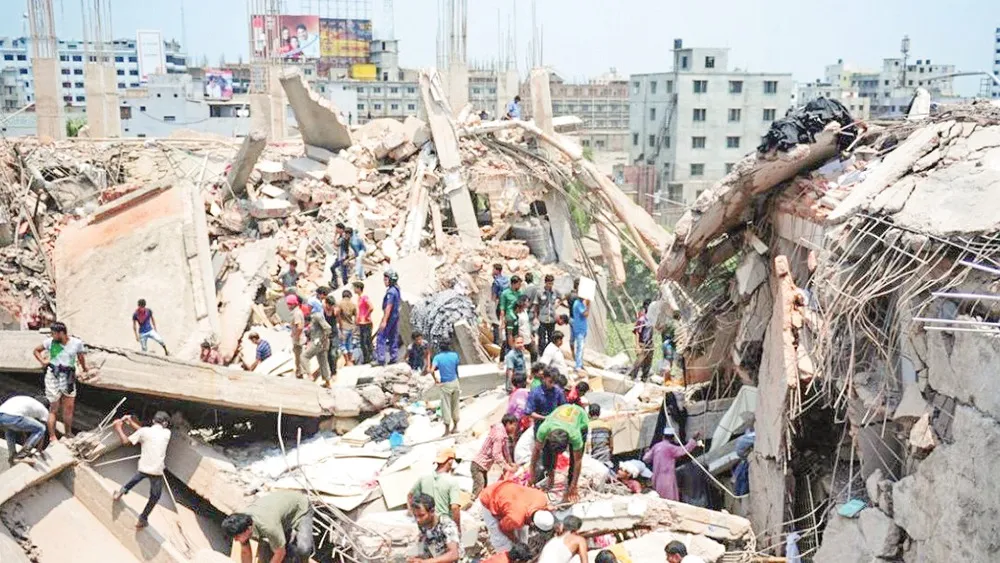
Thirteen years after the Rana Plaza collapse, justice, adequate compensation, and sustainable rehabilitation for the victims remain largely unfulfilled, according to affected workers and rights activists. The issue has once again raised serious questions about state responsibility and accountability in light of international human rights standards.
“I lost my hand in the Rana Plaza collapse. Not just me, many others lost limbs. Yet even after 13 years, we have not received proper justice, rehabilitation, or medical care,” said Saddam Hossain, a survivor of the tragedy. He added that although he had completed his Master’s degree before the incident, he has remained unemployed due to his physical disability.
Another injured worker, Nilufa Yasmin, said, “No one checks on how the injured workers and families of the deceased are surviving. Workers are still struggling on the streets. How long must this continue?”
They shared their experiences at a discussion titled “Rana Plaza Tragedy 13 Years On: Ensuring Justice, Compensation and Rehabilitation,” held on Wednesday (April 23) at the Jatiya Press Club in Dhaka. The event was organized by the Workers’ Safety Forum.
On April 24, 2013, the Rana Plaza building in Savar collapsed, killing 1,135 people, making it one of the deadliest industrial disasters in Bangladesh’s history.
Under international human rights frameworks, ensuring safe working conditions, the right to life, and dignity of workers is a shared responsibility of the state and employers. According to United Nations principles, such incidents require effective investigation, accountability, and adequate remedies for victims. Similarly, the Universal Declaration of Human Rights and the International Covenant on Civil and Political Rights guarantee the right to life and access to justice.
Human rights analysts argue that delays in the judicial process and gaps in rehabilitation contradict the principle of “effective remedy.”
Syed Sultan Uddin Ahmed, Executive Director of the Bangladesh Institute of Labour Studies (BILS), said, “Incidents like factory fires or building collapses are not merely accidents; in many cases, they are the result of negligence. Ensuring workers’ safety requires stronger grassroots movements and accountability at the local level.”
Labour leader Anwar Hossain stated that workers were forced to continue working despite known structural flaws in the building, raising serious concerns about employer accountability. “If workers had been more organized, such a tragedy might have been avoided,” he said.
Bishwajit Roy, Assistant Inspector General at the Department of Inspection for Factories and Establishments, noted that limited manpower makes it extremely difficult to monitor a large number of factories. He added that much of the department’s time is spent resolving unpaid wages, leaving safety oversight under-prioritized.
Ongoing Struggles of Victims
Workers and family members of victims said that while some immediate assistance was provided after the disaster, long-term rehabilitation, medical care, and employment opportunities remain inadequate. As a result, many survivors continue to live in uncertainty and hardship.
Experts emphasize that justice in cases like Rana Plaza extends beyond court verdicts. It includes fair compensation, proper rehabilitation, safe working conditions, and effective measures to prevent future disasters.
Thirteen years on, as victims continue to raise concerns about being deprived of their basic rights, a critical question remains: how much structural change has actually been achieved to ensure safety and accountability in the industrial sector?
The Rana Plaza collapse is not just a tragedy of the past, it remains an ongoing human rights issue, reflecting unfulfilled promises of justice and accountability.