

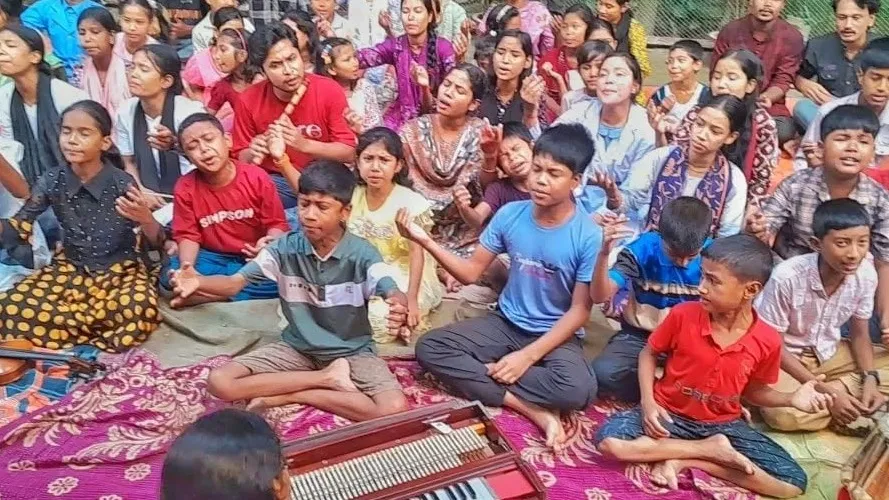
Children in the remote villages of northern Bangladesh are learning traditional folk music and musical instruments through the cultural and humanitarian organization 'Mayer Tori', helping preserve the region's rich cultural heritage while nurturing humanistic and moral values among the younger generation.
At the organization's Suraloy Gurugriha in Deodoba village under Aditmari upazila of Lalmonirhat, around 70 to 80 children are receiving training in folk music and traditional instruments, including the banshi (flute), ektara and dotara.
Through their voices and instruments, the children are keeping alive the melodies of Bhawaiya, Lalon, Baul, Marfati and Murshidi songs, connecting with the cultural traditions and musical heritage of rural Bengal.
According to the organizers, more than 600 children are currently involved in such activities at nine gurugrihas, or learning centres, across Lalmonirhat and Kurigram districts.
Yusuf Alamgir, one of the key organizers of 'Mayer Tori', told BSS that the initiative aims to help children develop self-awareness and a deeper understanding of life through folk music.
The programme enables them to reconnect with their roots while cultivating humanistic and moral values, he said.
Writer, journalist and cultural enthusiast Hamidur Rahman Hamid said many folk songs and traditional musical instruments of rural Bengal were at risk of disappearing because of a lack of regular practice.
The training programmes are helping children and adolescents rediscover these songs, melodies and instruments, ensuring that the traditions are passed on to a new generation, he said.
Sujan Kumar Bed, executive director of 'Mayer Tori', said social organizations and senior officials frequently visit the centres to observe their activities.
Despite limited financial resources and inadequate infrastructure, the organization continues to run cultural programmes at nine gurugrihas, he said, adding that most instructors in the remote villages work largely on a voluntary basis.
The organization is also pursuing plans to establish a permanent venue to ensure recognition and security for veteran folk culture practitioners, alongside a dedicated centre for folk culture research.
A modern studio is also needed to record and preserve audio and video performances by veteran folk artists and children from remote areas, Bed said. Such recordings could eventually form a digital archive of the region's folk music and cultural traditions.
District Cultural Officer Md Hamidur Rahman said free training in folk music and traditional instruments played an important role in preserving folk culture.
Expanding the initiative would require additional support, including training facilities, musical instruments and cultural infrastructure, he said.
Deputy Commissioner Muhammad Rashedul Haque Prodhan said the training provided to children in remote areas was contributing to the preservation of local culture.
He said the possibility of linking the initiative with government cultural programmes could be explored through the relevant departments.
Representatives of 'Mayer Tori' said the organization was founded in 2016 by Norwegian poet, folk researcher and photographer Vera Saether in collaboration with local artists and cultural organizers.
Saether first visited Bangladesh in 1998. During a visit to Dakshin Namajer Char in Roumari upazila of Kurigram following a flood, she became fascinated by the Marfati and Murshidi songs sung by local women, they said.
Her interest in Bengal's folk traditions later led her to translate 53 songs by Lalon into Norwegian, which were published in a book.
Over nearly a decade, 'Mayer Tori' has continued its activities despite financial constraints, inadequate infrastructure and limited technical facilities.
Through the voluntary efforts of its members, the organization provides children in remote villages with training in traditional instruments such as the ektara, dotara and flute, while encouraging them to practise and appreciate folk music.
The organizers said government patronage and cooperation from cultural institutions could help expand the initiative into sustainable, long-term programmes to preserve the folk music, traditional instruments and cultural heritage.